


Last week we took a brand from ₹20,000/day in spend to ₹4 lakhs/day in under a week. CAC dropped from ₹4,500 to ₹2,200. No discounts, no influencer blitz, no video-heavy funnel. 100% of the spend went on static ads, with over 200 ads running simultaneously.
Everything about this breaks conventional D2C wisdom - especially because this is a category-creating brand.
According to the standard marketing playbook, new categories require:
• Awareness campaigns
• Heavy consumer education
• Influencer distribution
• Video-first content
• Massive top-of-funnel budgets before you even think about scaling
None of that happened here.
So why did it work? The honest answer has very little to do with static ads and everything to do with demand.
And most founders get this wrong at step 0.
Most founders treat these as the same thing. They aren't.
Eg. If someone invented a teleportation machine tomorrow, they wouldn't need an awareness campaign. People already want to teleport.
Here are some other examples that will not need lots of education:
• A period pain relief patch that works in 10 minutes. Women have been waiting for this their entire lives, no awareness campaign needed.
• A 100% silent AC or a silent blow dryer. the desire is so obvious that the day someone builds it, it sells itself.
• A jacket that genuinely keeps you warm at -10°C without looking like a sleeping bag. every person who's been to Ladakh or Manali in winter knows exactly what this means.
• A true non-drowsy antihistamine. allergy sufferers have been lied to by every "non-drowsy" label for decades, so the day one actually works, word of mouth does everything
In all these examples the desire already exists. The category may be new, but the want isn't.
So OFC you will easily acquire initial customers easily through statics.
This leads you to spend lakhs on educating a market that was already ready to buy.
But now you will ask… what if you’re not selling a product that has such an existing electric demand on day 0? You will find out the answer in less than 30 seconds 😀

Most founders tell themselves: "We need to educate the market." That feels responsible. It feels strategic. It's wrong.
Your first job isn't education. It's recognition.
The first users of every successful new category aren't mainstream consumers. They're the people who have been quietly suffering from a problem, searching for something that doesn't exist yet, and coming up empty. When they finally see your ad, they shouldn't think "this is interesting." They should think "finally."
That's a completely different creative brief. And it requires a completely different understanding of how demand actually works.
Every market has a natural structure, and Meta's algorithm reflects it whether you understand it or not.
• Layer 1 - Early Adopters: Actively suffer from the problem. Have been searching for a solution. Convert almost immediately when they find something that clicks.
• Layer 2 - Need-Based Explorers: Open to something new, but need some proof and context before they move.
• Layer 3 - Followers: Need social signals, influencer validation, and popularity cues.
• Layer 4 - Skeptics: Need hard evidence and repetition before they trust anything.
• Layer 5 - The Burned Audience: Have tried everything and trust nothing. The most expensive customers you can possibly acquire.
Meta algo naturally starts with Layer 1. If your Layer 1 is large enough, scaling becomes surprisingly straightforward - because you're capturing people who are already halfway to the checkout page before they've even seen your creative.
The mistake most brands make is assuming that a new category means a thin Layer 1. Often it's the opposite. And understanding why requires understanding the most underrated concept in D2C marketing.
Everyone in D2C talks about Product Market Fit like it's the finish line. It isn't.
Here's the reality: in 2026, consumers are saturated with products. Almost every category has ten brands solving the same problem in roughly the same way. Getting product market fit by talking about the product alone is increasingly a dead end - because the product, by itself, is rarely enough to break through anymore.
What actually creates breakthroughs is Positioning Market Fit - and almost nobody talks about it.
• Product Market Fit asks: Does the product solve a real problem?
• Positioning Market Fit asks: Does the market instantly understand why this matters to them, specifically?
You can have one without the other. You can have a genuinely transformative product and still find yourself stuck in an endless cycle of explanation - not because the product is wrong, but because the framing hasn't clicked. And you can take an existing product in a crowded category, reposition it entirely, and unlock a pool of demand you were previously invisible to.
Positioning Market Fit is that moment when the way you describe what you do creates immediate recognition. The customer doesn't need to be convinced. They just need to see themselves in your message.
There are two ways to create demand.
Method 1: Product Innovation
Sometimes the product itself does all the heavy lifting:
• A projector that works in daylight
• A 150W charger that fits in your pocket
• A sleep solution that works the first night
The value is so functional and obvious that the market recognizes it immediately. The explanation is short because it doesn't need to be long. This works - but it's rare. Genuine product innovation is hard, slow, and expensive to build.
Method 2: Positioning Innovation
This is where almost all the real leverage lives. And the scale of the opportunity is not comparable.
Cinnamon Kitchen didn't invent cookies. They didn't invent veganism. They didn't invent PCOS. But they connected all three in a way nobody had before, and suddenly an enormous amount of latent demand had somewhere to go.
Gully Labs didn't invent sneakers - they repositioned sneakers as culture, as identity, as belonging. The product barely changed. The meaning changed completely.
But the clearest example of positioning innovation unlocking a completely different order of magnitude? Tesla.
Tesla didn't launch sustainable cars. Their vehicles aren't the most energy-efficient in the world - a Prius beats them on that metric by a wide margin. What Tesla actually did was reposition an EV as a sports car for people who felt guilty about driving sports cars.
Think about that customer for a second. They want a fast car. They want a sexy car. But they don't want the social and psychological cost of being seen as someone who doesn't care about the environment. Tesla gave them exactly what they wanted - performance, status, design - and removed the guilt.
The Prius (which was gold standard of electric vehicles pre-Tesla) targeted people who were dying to be sustainable. This specific, ideologically motivated customer was already looking for the most eco-friendly option available. Tesla targeted an entirely different person. They were rich, loved speed…and now they could indulge and claim to be saviours of the universe.
Same technology. Completely different positioning. Completely different demand pool. That's not a 2x difference - that's the difference between a niche product and one of the most valuable companies in the world.
This is what positioning innovation actually means: you take your existing product and unlock demand from a market that would never have considered you before. And the size of that unlocked demand is almost always 10x, 20x, sometimes 100x larger than what you were capturing before.
Static ads are not better than videos. That's not the argument. Static ads are better at demand capture, and that is a very different statement.
When someone already wants what you're selling:
• You don't need thirty seconds to explain it
• You need two seconds to make them recognize it
• One image, one headline, one idea - and they know
The stronger the existing demand, the less education the creative has to do. This is why early adopters convert so well through statics - they already understand the problem. They don't need a documentary. They need a signal that you understand it too.
Many brands are not using video because their product requires deep explanation. They're using video because their positioning isn't clear enough. The video is compensating for lack of clarity, not substituting for it.
Here's a simple test: if you can communicate your core value proposition in two seconds, spending twenty seconds doing the same thing isn't depth - it's inefficiency. The cleaner your positioning, the shorter your creative needs to be.
When we look at a static ad, we're not looking at a piece of creative. We're looking at a hypothesis - about what the customer believes, what they fear, what they desire, and what language makes them feel seen.
When we launched 200 ads for this brand, we didn't launch 200 creatives. We launched 200 theories. Each one was a different interpretation of demand:
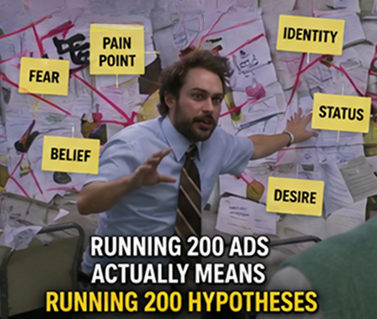
• A different pain point
• A different emotional entry point
• A different positioning angle
• A different customer belief
The image was never the asset. The idea behind the image was.
This is also why creative volume changes everything. Videos are slow to produce - you can test a handful of hypotheses a month. Statics are fast - your learning loops run at a completely different velocity. More experiments means more winners, which means a faster feedback loop on what the market actually responds to. Most brands are trying to make better ads. We're trying to run more experiments.
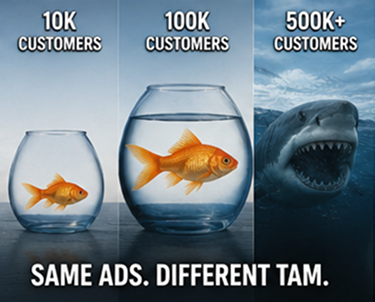
Statics won't scale any brand infinitely. The size of your early-adopter layer - which is directly determined by how well you've nailed Positioning Market Fit - determines how far demand capture can take you before you need to shift strategy.
• Small Layer 1 (10,000 early adopters): You acquire a few thousand customers profitably before the well dries up
• Medium Layer 1 (100,000 early adopters): The scale becomes dramatically larger
• Large Layer 1 (500k+): You can build a very serious business before awareness even becomes the bottleneck.
The bigger the TAM you've unlocked through positioning, the bigger your early-adopter pool, and the further demand capture can take you. This is exactly why Tesla's repositioning wasn't just a marketing win - it was a business model transformation. They didn't just sell more cars. They unlocked a pool of buyers that their previous positioning made completely inaccessible.
The brand we scaled had a large, underserved early-adopter base - not by accident, but because the positioning had found genuine resonance with a specific desire that was already there.
The lesson isn't "use static ads." It isn't "stop making videos." It isn't "launch 200 creatives."
The lesson is: demand capture scales faster than demand creation.
And more importantly: you can reposition your existing product to capture demand from a market you were previously invisible to. You don't need a new product. You need a new frame. And when you find that frame - when your Positioning Market Fit clicks - the TAM you're operating in expands, your Layer 1 gets larger, and suddenly statics start working in ways that feel almost unfair.
We didn't scale this brand because we used static ads. We scaled it because we found a market that was already screaming for a solution, and we gave it somewhere to land. The statics just helped that market recognize itself.
It feels oddly appropriate that our journey into category creation started with a brand selling orgasms.
Because category creation is fundamentally the art of making people desire something they didn't know existed.Or helping them realise they've wanted it all along.
From sexual wellness.
To PCOS.
To sleep.
To wearable air purification.
To culture first sneakers.
To stationery that is art itself.
To categories that don't even have names yet.
If you're building something unconventional and everyone keeps telling you there's no playbook for it...
That's usually when we get interested.
Book a call.
We have a habit of falling in love with and then scaling categories nobody else quite understands yet.
In a world optimized for speed and dopamine, meaning is the only thing that lasts.
Read the full storyIn a world optimized for speed and dopamine, meaning is the only thing that lasts.
Read the full story
Get your hands on the the stuff that actually compounds.
Positioning. Retention. Content. Community.

Welcome to Finsweet's accessible modal component for Webflow Libraries. This modal uses Webflow Interactions to open and close. It is accessible through custom attributes and custom JavaScript added in the embed block of the component. If you're interested in how this is built, check out the Attributes documentation page for this modal component.
See docs