

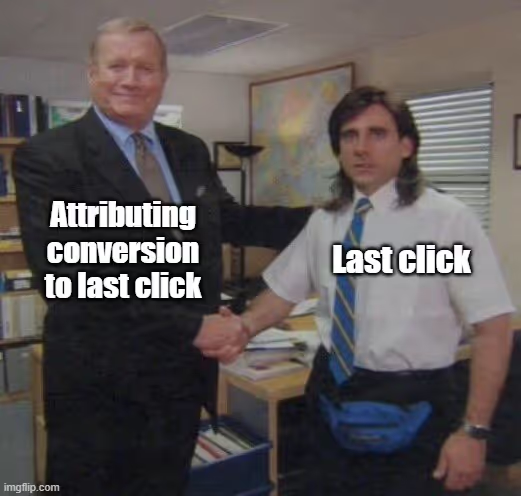
Most brands think growth works like this:
Simple.
Clean.
Completely wrong.
The problem isn’t effort.
It’s attribution.
Most founders/ marketers trust what their dashboard tells them:
So they optimise accordingly.
And slowly… they start breaking their own growth engine.
We’ve seen this enough times to know exactly what’s happening.
The issue isn’t that certain channels don’t work.
It’s that they don’t get credit.
So instead of debating it with founders…
we prove it.
With incrementality tests.
It’s the closest thing you’ll get to truth in marketing.
You remove (or isolate) one variable…
keep everything else constant…
…and observe what actually changes.
Not what gets attributed.
What actually changes.
This brand was doing:
On any dashboard, YouTube looks like a bad decision.
Which is exactly why most brands cut it.
We didn’t.
Because we knew what was happening.
YouTube wasn’t converting.
It was creating demand.
The problem was:
We needed to prove it.
Not to ourselves.
To the founder/management
So we designed a test.
We increased YouTube spend…
But only in one state.
Maharashtra.
Everything else remained unchanged.
One variable.
Before the test:
Then we waited.
6 months.
Here’s what happened: (MH only)
Month 1: 3.2
Month 2: 3.2
Month 3: 3.5
Month 4: 3.6
Month 5: 3.6
Month 6: 3.6
We increased spend on a channel showing <0.5 ROAS…
…and the business became more profitable.
This one is even more dangerous.
Because this time, the data looks clean.
Google Analytics showed email contributing <3% of revenue.
A new D2C lead joined the brand.
First instinct:
“Let’s shut email down.”
Again - we knew what was happening.
Email wasn’t being credited.
But it was driving behaviour.
So instead of debating…
we tested it.
We stopped all email communication in 3 states:
These states contributed ~18% of revenue.
No changes to ads.
No changes to anything else.
3 months later:
Same business.
Only difference?
No email.
Different channels.
Same truth.
Channel
What attribution says
What actually happens
YouTube
<0.5 ROAS, Drives demand + revenue
<3% revenue, Impacts CAC + conversion
Attribution tools answer:
Who got the credit?
But growth comes from:
What actually caused the outcome?
And those are not the same thing.
If you optimise for attribution:
If you optimise for reality:
You don’t need complexity.
You need conviction.
These tests cost money.
You will:
But not doing this costs more.
Because then you build your business on the wrong signals.
And at scale…
that breaks everything.
If you still rely on ROAS per ad or per channel to make decisions…
you’re not optimising your business.
You’re optimising your attribution.
In a world optimized for speed and dopamine, meaning is the only thing that lasts.
Read the full storyIn a world optimized for speed and dopamine, meaning is the only thing that lasts.
Read the full story
Get your hands on the the stuff that actually compounds.
Positioning. Retention. Content. Community.

Welcome to Finsweet's accessible modal component for Webflow Libraries. This modal uses Webflow Interactions to open and close. It is accessible through custom attributes and custom JavaScript added in the embed block of the component. If you're interested in how this is built, check out the Attributes documentation page for this modal component.
See docs